Showing posts with label comics. Show all posts

Thursday, 1 July 2010

Isn't it a wonder?


We all have our favourite items of clothing. It could be a Pixar-worthy Hawaiian shirt, a pair of jeans with more holes than the plot of Independence Day, or an LBD that even Monica Lewinsky would keep dry-cleaned.

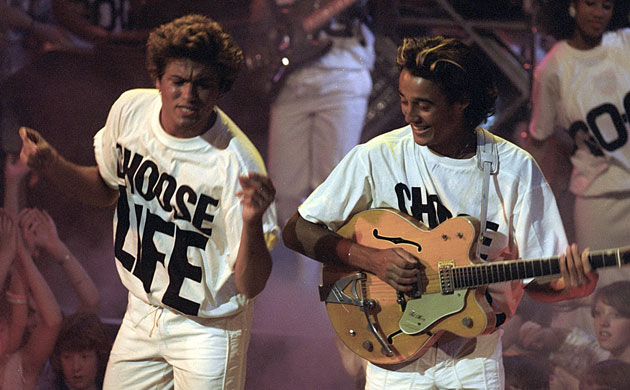
They're the kind of garments that exist outside of regular fashion trends, so we tend to cling on to them as long as the stitching holds out. It doesn't matter that they might have been all the rage when George Michael was still wearing a 'Choose Life' T-shirt - they make us feel even better than we think they make us look.

It's a sad day when those items finally give up the ghost and get dumped in the clothes recycling unit outside the supermarket. Just last week I had to part with a garish T-shirt that I've held onto since I was an undergraduate - it didn't seem to matter that the only way I was ever going to fit into it was if I started to chronologically regress like Benjamin Button.

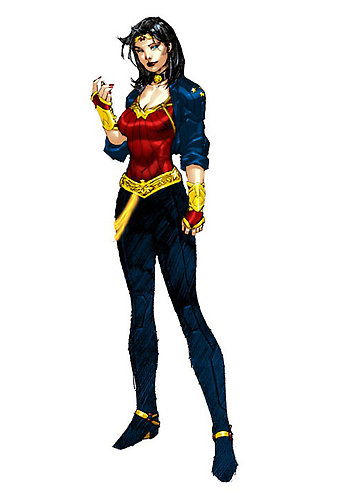
So I can totally empathise with Wonder Woman, who has been forced to mothball her hotpants and bedazzled bustier in favour of a more contemporary ensemble. In some ways it must come as something of a relief for the pushing-seventy crime fighting Amazonian. She leads a hectic life as it is, without having to rinse out that stripper gear every night and hang it over a radiator to dry.

It's not the first time that the creative team behind the statuesque star have tried to revamp her image. In the late sixties she was given a contemporary mod-makeover, only for pre-eminent American feminist Gloria Steinem to argue for a return to form, as well as a form-fitting costume.

Several decades later, novelist Jodi Picoult was drafted in to remodel the character for a noughties audience, and commented “One of the first things I did was ask if we could give her breast-reduction surgery, because as a woman, I know you wouldn’t fight crime in a bustier. But I was somehow shot down by DC.” Now you can't say that superhero comics don't address the issues that matter.

So now we get the 2010 version of Diana Prince's lasso-brandishing alter-ego. With "an understated “W” insignia, a midnight blue jacket and a flinty fusion of black tights and boots" she's still the second gayest thing in comics (running a close second after Robin's wank-bank. But at least she can now take down a bunch of hoodlums without worrying that her glittery top will follow.

Anyway, for old-time's sake, here's Lynda Carter in all her sparkly, window-leaping finery...

Monday, 22 June 2009

Hero to zero

Marvel Comics are currently riding the crest of a wave, with Spider-Man, X-Men and Fantastic Four all launching highly lucrative franchises, as well as Iron Man and The Incredible Hulk bringing up the money-making rear. But there's one key comic title yet to find its place on the silver screen, largely because no-one knows quite what to do with it.

X-Men were originally created in the early 1960s, clearly intended as a commentary on prejudice and injustice in contemporary society. Similarly, the Incredible Hulk was a Jekyll/Hyde update that dared to make the monster within the hero of the story.

But back in the 1940s, Marvel's agenda was a little more conservative. Captain America was created in 1941, as an aid to the war effort. The alter ego of Steve Rogers, Captain America was a four-colour propaganda machine, enhanced by an experimental serum designed to help the US war effort, and wearing a costumer based on the American flag.

By the 1960s, while his stable-mates were busy overthrowing the Man, the captain's relevance and integrity had long since begun to fade. Instead, he was depicted as a reverse Austin Powers, defrosted from suspended animation and trying to adapt to contemporary society.

Flash forward forty years and some people are asking questions why Steve Rogers has yet to take his turn on the big screen. One right wing cartoonist, Bosch Fawstin, has asked why Captain America hasn't been depicted going after the Jihadists responsible for 9/11. Even though Marvel actually ran a story showing the square jawed hero going after a terrorist cell, Fawstin isn't happy because the terrorist leader was depicted as 'having his reasons'. But isn't that the point of terrorists - that they have reasons for what they do?

Ultimately, the creators of Captain America knew that they'd created a short-term propaganda tool. In his first incarnation, the Captain was shown punching out Adolf Hitler, and for a nation about to be plunged into world war, that was deemed appropriate. But by the end of the Second World War, there was little else for him to do, which is why he ended up in suspended animation.

As a consequence, the point of the character is not to celebrate blind patriotism, but to question how we might reconcile old world ideals in an ever-changing world. Perhaps once Hollywood grasps that concept, there'll be a film worth making.