Showing posts with label Catholic Church. Show all posts

Monday, 11 April 2011

Aisle be there


Oh deary me. It looks like there's a crisis in the church, and it's got nothing to do with a crumbling steeple or woodworm in the trestle tables. Attendance at services is dwindling to such a degree that, in Britain, only 15 per cent of the population go to church once a month.

According to a study conducted by economists at the universities of St Andrews and East Anglia, young people begrudge spending a large amount of their time in church, given that death is still a long way off. Conversely, it's pensioners who make up the majority of congregations, since they're keen to secure their ticket to the impending afterlife. Turn up once a week for guaranteed access to the kingdom of heaven and 500 Tesco Clubcard points.

Although this phenomenon has been observed in the majority of wealthy western nations, it's particularly prevalent in the UK, which has seen the Church of England adopting all manner of 'trendy vicar' techniques to try and engage the young folk. Researcher Dr Elissaios Papyrakis reckons that "religious organisations should be prepared to accept and attract a 'greying church', with membership skewed towards the older generation, particularly in countries which have high life expectancy."

The Church of England was quick to respond to the academics' findings, claiming that the study "made a number of assumptions about why Christians want to share their faith. Age really isn’t the important thing. It is the duty of every Christian to share the good news of the gospel with those who haven’t heard it, irrespective of age."

That may be their 'duty' but I'm not sure it's the reason why many people bother to go to church. Call me a hell-bound cynic, but I have a feeling that half the regular attendees only show up to get their hands on the keys to the church hall for a few rounds of knockout whist.

But that's the nature of the Church of England. It's not so much a religion, more a social network for the over-seventies. Plus, I guess when your days are numbered, you want the time to drag by, like you're stuck in the fourth dream layer of Inception.

I remember, years ago, having a meeting with the marketing director of Brewers Fayre - the popular family pub brand. She told me that they faced an unusual paradox, in that they were the nation's favourite family restaurant, but their customers didn't really enjoy food. So it was a restaurant for people who weren't fussed about eating. I'll pause for a moment to let the analogy sink in...

And we're back in the room.

The Catholics have their guilt, the Baptists have their zeal, and the Salvation Army have their brass instruments. The Church of England has a bunch of anxious looking brides, biting their lip through the service just so they can get some half-decent wedding photos.

Whether you like it or not, there's something quintessentially English about a religion that's more interested in bake sales than salvation. Having said that, the next time you see me I might well be pinned to the ground by a lightning rod, like Patrick Troughton in The Omen. In which case, I take it all back...

Tuesday, 8 February 2011

Forgive me iPhone, for I have sinned


Well, I guess it was only a matter of time. We live in world of convergence, where the overlap of trends and ideas has become a matter of eventuality, rather than possibility. 

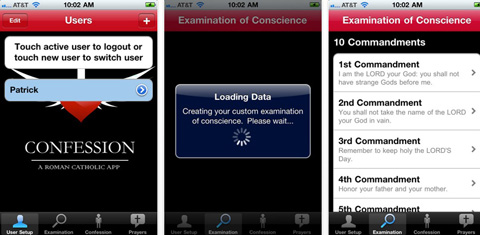
So I don't even find the energy to be surprised that the Catholic Church has approved the development and launch of a new iPhone app "to invite Catholics to engage in their faith through digital technology."

For a few years now, the Church has been struggling to find its place in our modern, GPS-enabled, augmented version of reality. At the same time, developers seeking their fortune have found the world of apps to provide a seemingly inexhaustible source of inspiration. As a result, these two unconnected trends have been racing towards each other, like theoretical trains in a high school maths problem. 

At the point of impact, in amongst the smoke and twisted metal, we find ourselves faced with the prospect of an app called Confession (available for £1.19/$1.99). Penitent sinners, who find themselves too time-poor to sit in a cupboard and spill their guts to a priest, can now input their wrongdoings into a handy piece of software.

The BBC's coverage of the story points out that this newest wrinkle in the gradual modernisation of Catholicism follows on from the Pope's recent approval of social media. Last month, in his World Communications Address, Benedict XVI told young believers that the new technology provided a useful forum for people to share information with each other: "I invite young people above all to make good use of their presence in the digital world... It is important always to remember that virtual contact cannot and must not take the place of direct human contact."

Despite this warning, Confession's virtualisation of the penitence process suggests that Priests are being increasingly removed from many people's day-to-day religious behaviour. It's much easier to click your way through a bunch of tabs that help you to examine your conscience, rather than articulate your darker moments out loud. 

More importantly, it also highlights the misgivings that many people have about the concept of Confession itself - that people can act with impunity, as long as they're willing to atone for their wrongdoing later. I'm not sure exactly what God told Moses on Mount Sinai, but I'm willing to speculate that his briefing made no mention of developing an algorithm that enables people to "keep track of their sins".

It'll also be interesting to see how much trust people are willing to place in the concept of ecclesiastical privilege. Given the frequency of security breaches and hacked accounts, it's hard to imagine the world's Catholics being willing to sign up to an online archive of all their moral shortcomings. Suddenly, the whole Wikileaks controversy is starting to look like a Jonah's storm in a teacup.

Friday, 4 February 2011

Wand direction

Harry Potter hasn't had an easy life. By day he lived the life of a suburban Cinderella, and his nights were spent huddled in a cupboard under the stairs. Thankfully, the admissions staff at Hogwarts managed to spare us seven turgid volumes of 'A child-wizard called It', and invited him to attend a school more suited to his precocious magical leanings.

And that's where his problems really started. Werewolves, Dementors, two-faced teachers and giant serpents made his school days even more perilous, as he gradually came to terms with his doom-filled destiny. But even Voldemort and his troop of Death Eaters are no match for his newest enemy - the Catholic Church.

Leaping into action (approximately a decade too late), the Catholic Truth Society has published a new self-help guide called 'Wicca and Witchcraft: Understanding the Dangers'. They're concerned by the growing popularity of Wicca and paganism, brought about by Hollywood's renewed interest in all things magical.

The booklet "offers parents advice on what to do if one of their children takes an interest in witchcraft" and even gives tips on evangelising witches in the local pub. Which should at least be more entertaining than another round of karaoke or a dominos tournament.

Author Elizabeth Dodd, a former Wiccan who converted to Catholicism, reckons that the majority of 'witches' are young women looking for some kind of spiritual experience. And she thinks that this makes them ripe for conversion.

It seems that, in Dodd's eyes at least, the world is only big enough for one book about a child born to fulfil his destiny, death and resurrection, conjuring tricks and the eternal battle between good and evil. And J.K. Rowling didn't write it.

The Catholic church is struggling to maintain its relevance in contemporary society, and I'm not convinced that a conversion campaign is going to help matters. Ultimately, this is just the religious equivalent of McDonalds publishing a pamphlet alerting fast-food junkies to the dangers of Burger King. And it's just as full of Whoppers.

Wednesday, 15 September 2010

What's the scoop?

Megastars are notorious for throwing tantrums when things don't go their way. So it's highly likely that the Pope's closest advisors are currently learning to duck like Naomi Campbell's housekeeper as his Holiness vents his anger at the massive misfire of his forthcoming UK tour.

The whole venture has been one long PR disaster, from the politically charged atmosphere surrounding the abuse cover-ups to the 'embarrassment' caused by the creation of a pamphlet explaining Catholicism in more contemporary lingo.

Now, with the news that thousands of tickets remain unsold for what was promised to be a kneeling-room-only affair, the Catholic Church is having to try and convince the public that "Catholics are looking forward to this visit very much indeed". It's a good job, since the rest of the population seems decidedly non-plussed about the least anticipated tour since Cher's decade-long 'farewell'.

In a time of penny-pinching cutbacks, the estimated £12 million cost of the pontiff's visit is harder to swallow than a pillow-sized communion wafer. It's not all bad news though, since a BBC poll found that 70% of British Catholics believe that the Pope's visit will "help the Catholic Church in the UK".

One person who's delighted about the impending arrival of everyone's favourite one-time Nazi is ice cream maker Antonio Federici. His company's new ad campaign is notching up some major news coverage on account of its controversial depiction of lustfulness inside the church.

With its heavily eroticised imagery of pregnant nuns and interracial gay priests, the campaign has clearly been designed to get people hot under the dog-collar. And although the Advertising Standards Authority has demanded that the 'immaculately conceived' ad be discontinued, Federici plans to replace it with a similarly provocative image that would be "a continuation of the theme".

The press attention generated by the campaign must far outweigh the impact of whatever media spend has been invested so far, and media observers are now on the edge of their pew waiting to see what image will appear on poster sites around Westminster Abbey. Just don't be too surprised if it's a choir boy being offered a Rocky Road by his Father Confessor.

Monday, 15 February 2010

Top of the Popes


It will go down in history as the day the music died. Last week, and seemingly without warning, Google took the unprecedented step of deleting a number of music blogs.

Perhaps fearful that it would be held accountable for aiding the growth of music piracy, the internet giant decided on a pre-emptive strike and simply eliminated the offending sites.

Years of work were obliterated in a flash, as a host of bloggers representing every music genre received a cordial note that said "We'd like to inform you that we've received another complaint regarding your blog. Upon review of your account, we've noted that your blog has repeatedly violated Blogger's Terms of Service ... [and] we've been forced to remove your blog. Thank you for your understanding."

Their crime was to offer links to filesharing sites where music tracks (some new, some dredged up from the archives) could be accessed by the blogs' readers. As Thursday's report in the Guardian correctly asserts, many of these bloggers operated with the tacit approval of the record companies who regularly send out promos and carefully orchestrate leaks in order to ensure that their music finds the die-hard fans first.

This leaves music fans with a major problem - in the aftermath of "musicblogocide 2010", where can they go for reliable, up-to-date recommendations on the music they need to hear?

Weirdly, it seems that the Vatican is willing to step into the fray and play unofficial DJ for today's musical youth. Following the success of last year's Alma Mater, Pope Benedict XVI's debut CD, the Catholic Church has decided to branch out into playlist territory.

Still, at least this will give people something to listen to while the octogenarian ex-Nazi works on his difficult sophomore album. RedOne has booked some studio time, and American Idol judge Kara DioGuardi has a few demos knocking around that the Pontiff may be interested in.

Of course I jest. But not about the music recommendations - the Holy See’s official newspaper, L’ Osservatore Romano has published a list of what it considers to be the top ten rock and pop albums of all time. Although, sadly, Britney Spears has been criminally overlooked.

The list itself is pretty surprising, featuring some inarguable classics, such as The Beatles' Revolver, Pink Floyd's Dark Side of the Moon and Fleetwood Mac's Rumours. It's a far cry from the days when rock music was decried as evil - in fact, Pink Floyd previously earned a shout-out from His Holiness in 1996 when he included them in a list of 'instruments of the Devil' which 'endangered young people's souls'.

The fact that L’ Osservatore Romano is moving towards a more populist approach should be applauded. But once again, it provides further evidence that organised religion offers few immutable truths that can stand the test of time.

As society adapts, these systems of belief need to acknowledge the changes and evolve accordingly. It's just a shame that they're quite happy to review their position on matters of popular culture, but the bigger issues, which sometimes equate to matters of life and death, remain exempt from discussion.